
Monday, April 27, 2009

Did You Know it Was a Holiday?

If you’re like most Americans, you probably didn’t know today was a holiday (okay, technically, it was on Sunday). You probably didn’t join a protest or participate in a vigil on the courthouse steps unless you are a member of the NAACP or the Sons of Confederate Veterans. And unless you are an employee of the state of Georgia, Mississippi, or Alabama, you most certainly didn’t get a paid day off in honor of Confederate Memorial Day.

I knew that there was a Confederate Memorial Day, although for some reason I thought it was aligned with Robert E. Lee’s birth date. It seems the date commemorates Confederate Gen. Joseph E. Johnston's surrender to Union Gen. William T. Sherman in North Carolina on April 26, 1865. Since Johnston was charged with Georgia's defense—and based on all of the things Sherman burned in Georgia, Johnston did a really lousy job—this marked the end of the state's participation in the Civil War. I can only assume that Mississippi and Alabama use the same reasoning. In reading some of the tiny amount of media coverage regarding the holiday—seems almost everyone is tired of this issue—I found some shrill, predictable, and ridiculous quotes. I just have to share.
"It's very easy to vilify our Confederate ancestors and write them off," commented Robert Reames, Alabama commander of the Sons of Confederate Veterans. "They were the greatest heroes this country has ever produced." That seems pretty strong language considering all of the heroes of foreign wars against America. Or did he mean America? But in regard to slavery as the cause of the “War of Northern Aggression” he said it is simply “what's being taught through the schools through Yankee books from Yankee publishers telling the Yankee side of the war." You just can’t make stuff like that up.

But not to be outdone, Mississippi NAACP president Derrick Johnson said, “It is a remnant of Mississippi's segregated past. Could you imagine Israel celebrating Hitler day.” I’m sure Mr. Johnson was simply out that day at diplomacy school.

The issue is simple for me. I do think we should memorialize the Civil War and remember it so that we don’t repeat those mistakes again. After all, over 620,000 soldiers and an unimaginable number of civilians were killed, compared to 416,800 fallen U.S. troops in WWII. But I’m not terribly concerned with keeping the Civil War battles going. It ended. The South lost. Let’s move on. And I’m glad Georgia changed the flag... again. Twice. But what concerns me greatly is that well over a hundred thousand Georgia employees are getting paid to take this day off. Seems like a great way to save some tax dollars in a bad economy.

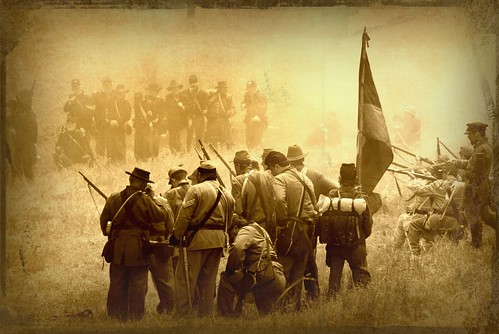
Oddly enough, my community has a Civil War reenactment scheduled for this week. Regardless of the agendas of some of the attendees and participants, it’s a pretty well run event that accurately portrays two battles. With any luck, I’ll have some great new shots to share next week.

Until then, for you lucky state employees, I hope you enjoyed your day off. For the rest of us, get some rest. We deserve it.

Friday, April 24, 2009

I'd Rather Fish, Thanks


No so long ago, while contemplating a difficult decision, a very good friend told me it was time to, “fish or cut bait.” It was good advice then—and it still is good advice. It’s been a blue week. And as I often do, I break out the Nikon when I need a dose of therapy. For subjects, I pulled out two of my most prized possessions, an antique Pflueger reel made in the 1950s and a truly vintage wooden lure of unknown manufacturer likely made around 1908, both gifts from a friend.

In case you are wondering, this was shot with my Nikon 24 -70mm, f2.8 (1/80 at f5.6) and two flashes, one gridded overhead and the other from beneath with a blue gel.

Outside as I worked, the rain and thunder of an unexpected storm spoke angrily. I turned on my iPod for something to preoccupy my mind. Through the din of random thoughts ricocheting around in my mind, Michael Stipe cut through with a lyric I had never really noticed before. “Where is the ripcord, the trapdoor, the key? Where is the cartoon escape-hatch for me? No time to question the choices I make, I've got to follow another direction. Accelerate.”

Monday, April 20, 2009

Remembering Otis Redding

Today I visited the Georgia Music Hall of Fame on the closing day of “I’ve Got Dreams to Remember,” a collection of music, photographs, film and artifacts documenting the career, life, and death of Otis Redding. My only regret is that I didn’t go see this exhibit sooner, so that I could recommend it to others.

The exhibit’s photography was indeed compelling, with many images of Redding early in his career. My favorites were the studio photographs, showing him working with such greats as Booker T. Jones, Steve Cropper, and Donald “Duck” Dunn. And a series of photos from the 1967 memorial service at the Macon City Auditorium showed the outpouring of support, both from black and white fans. A friend told me just this past Saturday that she skipped school to attend the memorial. Caught by a television camera and seen on the evening news by her father, she was grounded for a week. “Was it worth it?” I asked. “Oh yes,” was the reply. “No regrets.”

Otis Redding was immensely influential on the music world, despite having an all-too-brief career. In 1962, Redding recorded These Arms of Mine on the Volt label, a Stax subsidiary, and the song reached #20 on the R&B billboard and #85 on the pop billboard. Five years later, and just four days before his death, Redding recorded (Sittin’ on the) Dock of the Bay. Produced by guitarist Steve Cropper and released posthumously, the song was ironically the only Redding song to climb higher that #21 on the Top 40 charts, holding the number one spot for four weeks in 1968. Dock of the Bay was a turning point, a Dylan-like departure from Redding's soul roots, representing something of a crossover toward pop music. Had death not ended this career so short, who knows what Redding might have achieved.

Aretha Franklin, The Black Crows,The Blues Brothers, and so many other acts benefitted from Redding’s songwriting genius and musical influence—as have I. Today, few know that Respect was written by Redding. And unfortunately, Hard to Handle is much more synonymous with the Black Crows. As a musician, I am very proud to play so many of his songs. And I'm also convinced that if I every make it as a musician, I may may pull a John Madden an only take the bus.

One of the most compelling items on display in the Redding exhibit is a poster for a concert at The Foundry, in Madison Wisconsin on December 10, 1967, featuring Otis Redding with the Bar-Kays. Ironically, the opening act was a band called the Grim Reapers, who would later become Cheap Trick. The Grim Reapers played one set before Redding’s death was announced to the crowd.

Like virtually every artist reaching greatness, Otis’s career caught a huge break. He was the driver for Johnny Jenkins, the bandleader of the Pinetoppers, who did not have a driver's license. Redding would later front the group. Two years later, his stint with the Pinetoppers led to an opportunity to record These Arms of Mine in Memphis. But quicker than fate brought fortune, it brought a Beechcraft 18 aircraft down in Lake Monona near Madison, Wisconsin on December 10, 1967. What an incredible lesson in taking advantage of the opportunities life brings, and living life to the fullest, as any day might be the last.